
You can measure how much a word matters by the number of places it shows up. At ai-PULSE 2026, “sovereignty” was in the opening keynote, in the panels, and on the totem planted outside the entrance to Station F, signed by AMD: “Choice enables sovereignty”.
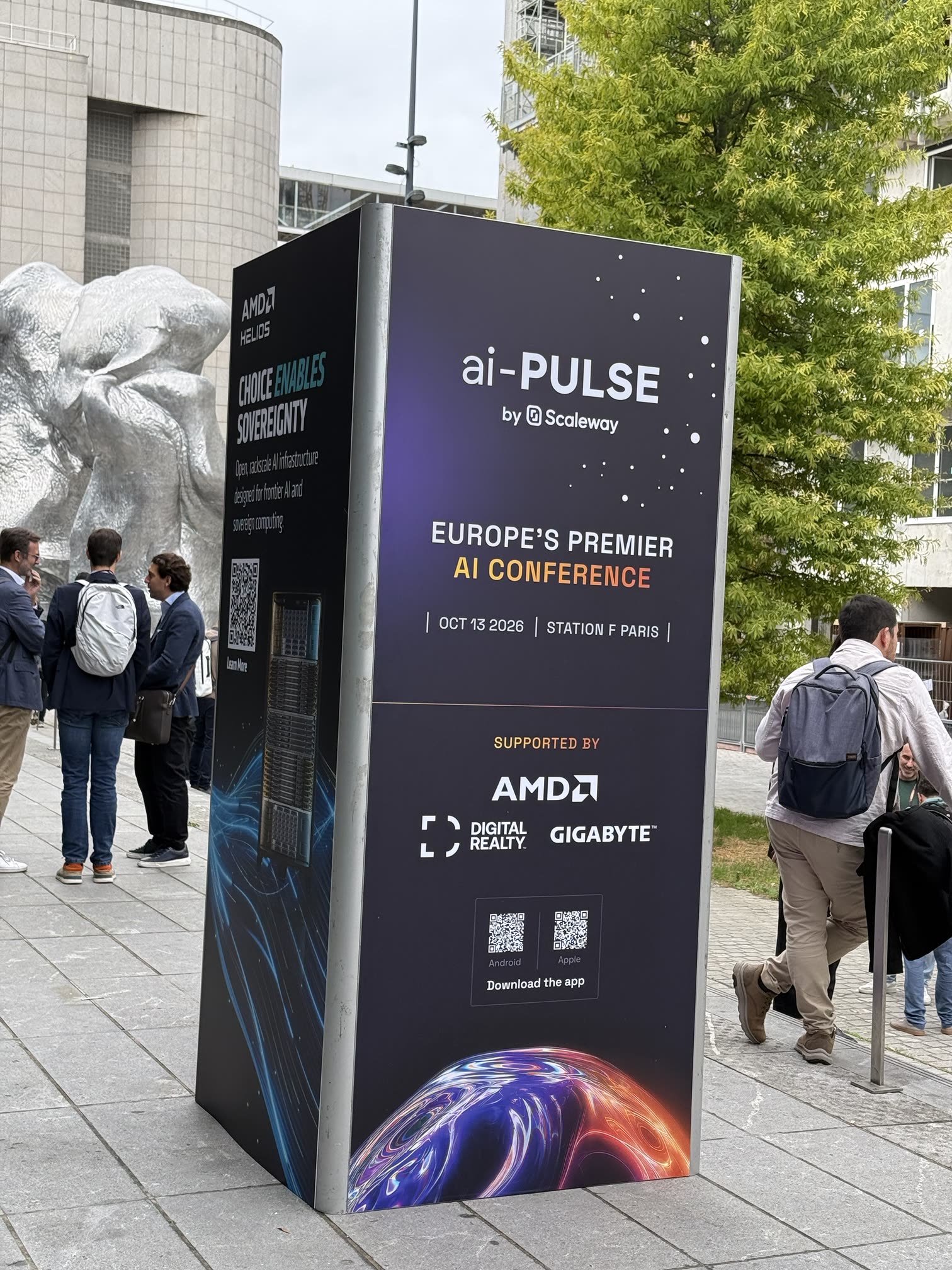
The slogan is clever. It moves sovereignty from geography to choice: being sovereign is not only hosting in Europe, it is being able to switch providers. Coming from the challenger to the near-monopoly in place, it is obviously self-serving. That does not make it wrong.
Scaleway’s three keys
Scaleway had organised its day around three themes, presented as three keyboard keys. ENTER: AI lowers the barrier to entering a market, including for established players who want to grow alongside their core business. SHIFT: models, hardware and product categories move too fast for fixed roadmaps. CTRL: the more powerful AI becomes, the more you need to stay in control — knowing who runs the model, where the data goes, what an agent can access.
The hard part is everything around the model
The first speaker of the keynote, Raffi Krikorian, CTO of Mozilla, set the frame. According to Mozilla’s State of Open Source AI report, the performance gap between open and closed models is around 3%. Yet open models make it into production less often.
His explanation: tooling. “If you use OpenAI or if you use Anthropic, you just give them a credit card.” With an open model, you have to build everything yourself: evaluations, observability, on-call, compliance, auditing. He calls it “layer eight”; others call it the agentic harness. That is where the game is played now, no longer on the model.
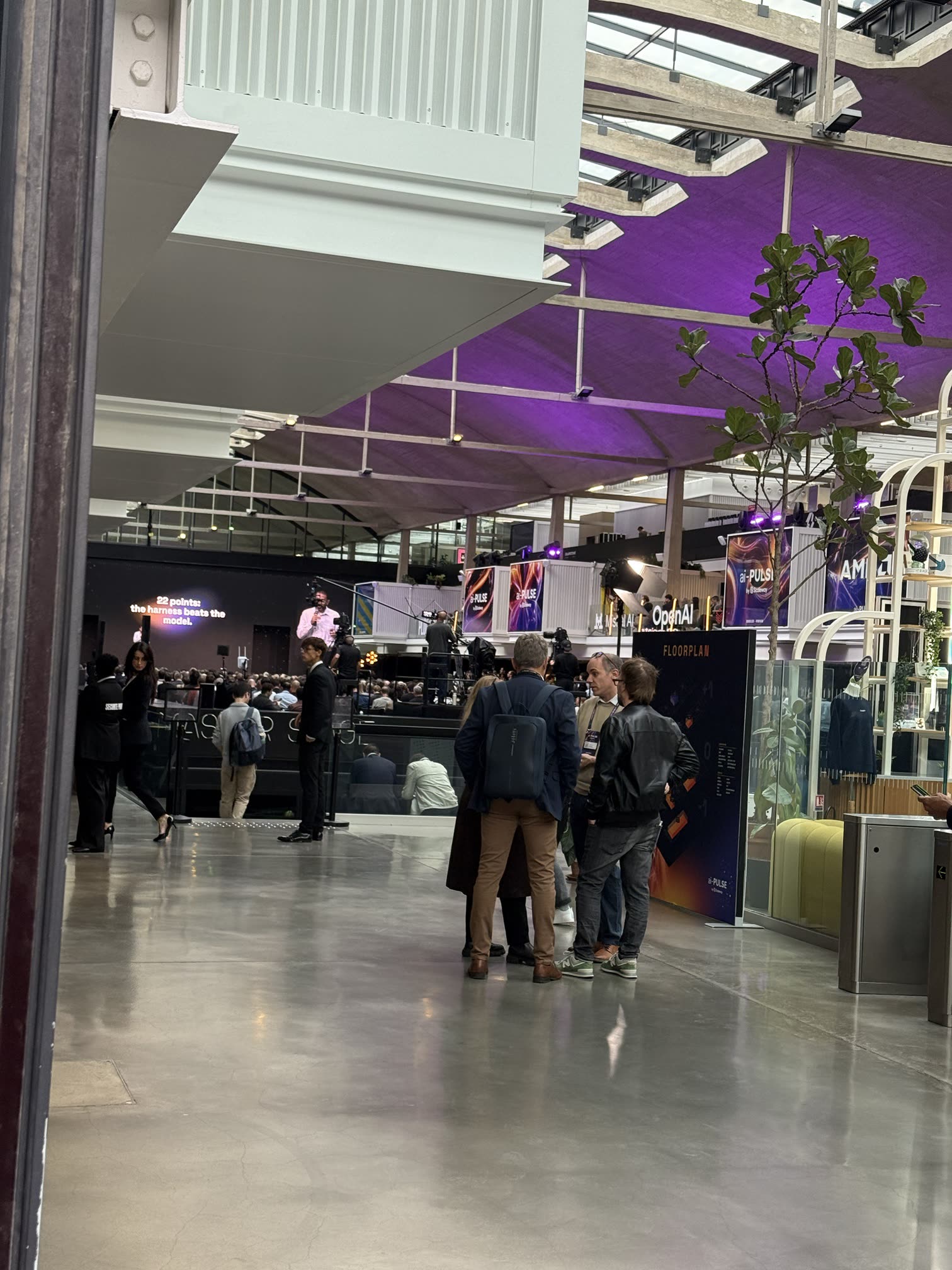
His example: on TerminalBench, with the same model, changing the harness gives a 22% gain on coding tasks. Open source is starting to fill the gap. He cited OpenCode, Goose and OpenHands for the agent’s reasoning layer. Mozilla itself is pushing Thunderbolt, an open source AI client from the Thunderbird team that you host on your own systems. Raffi Krikorian works at Mozilla: he is making his own case. But the point matches what I saw elsewhere during the day.
He also gave the most useful definition of sovereignty of the day: “sovereignty without portability is just another landlord problem”. Moving to an open weight model solves nothing if the company’s memory, workflows and intellectual property stay locked inside a platform.
Open weights as an argument
Two speakers came to defend the same idea from opposite sides of the globe.
Pierre Stock, VP Science at Mistral and the company’s first employee, presented Mistral Large 4, nicknamed “Le Chonk”: a mixture of experts with 1,050 billion parameters, 49 billion of them active per token, a one-million-token context window and native image input. It was trained in Bruyères-le-Châtel, on less than 10 megawatts. The API is open. The weights are announced for the end of October, after a red-teaming phase with trusted partners and governments. His argument for cyber defence: you cannot cut off access to an open weight model, and there is no API to refuse the task.
Then Esmie Wang Hui, general manager of Alibaba Europe, came to talk about Qwen. Same arguments, with three reasons to publish the weights: speed, thanks to thousands of derivative models; trust, because you can look inside; and adoption. Alibaba says it wants to keep a permissive licence so that people can build a business on it, without naming the licence. Her advice to European companies: start with high-volume tasks, such as customer support or data extraction, on an open model hosted on a trusted European platform, and keep closed APIs for the hard problems. She puts the savings at 60 to 80% compared with closed models. That is her figure. No announcement of Alibaba hosting in Europe: the advice is to go to a European hosting provider.

A word on what “open weight” means, because the term is used a lot and covers something precise. The provider publishes the model’s weights: you can download it, run it on your own infrastructure, quantise it, fine-tune it, audit it. It is not open source in the strict sense — the training code and above all the data are generally not published, and the licence may restrict commercial use.
What matters in practice, for anyone handling sensitive data: no outbound calls, customer data never leaves the infrastructure, and no dependence on a vendor’s moderation or pricing policy. That is sovereignty in practice, not a slogan.
One detail in Mistral’s figures deserves the attention of people who work in security: 93% on Cybench and 82% on CyberGym-E2E, with the argument that several closed models score close to zero on CyberGym because they refuse the task. Figures announced by Mistral, not independently reproduced. But the question they raise is real: a model that refuses offensive tasks is useless for security auditing.
What Scaleway put on the table
Damien Lucas, Scaleway’s CEO, then went through the announcements.
On regions, Milan goes into production with the opening of its second and third availability zones. Stockholm and Frankfurt will follow in 2027, with three zones each. Three zones per region is what you need to host a resilient service without leaving the country.
On GPUs, Scaleway is opening dedicated GPU zones. Copenhagen will get thousands of Nvidia B300s. In Sweden, a supercomputer with 696 AMD Instinct MI355X, announced by video by Lisa Su. Scaleway presents itself as the first European cloud to offer AMD GPU clusters. With Paris, that makes three GPU zones and, according to Scaleway, tens of thousands of GPUs. It is a way to close Europe’s computing capacity gap.
Damien Lucas was candid about the limit of the exercise. “Do your services run on sovereign European hardware? Well, they don’t.” Hence the partnership with VSORA, a French start-up, for inference on European chips.
On models, more than 40 are already in the catalogue, including DeepSeek V4 Flash and a new version of Qwen, added a few weeks earlier. Three joined on the day: GLM 5.3 from Z.ai, DeepSeek V4.1 Flash, which now natively understands images, and LightOn OCR 3, a character recognition model from the French company LightOn. Mistral Large 4 will follow as soon as Mistral opens it to its partners.
Two Chinese models and one French, all served from Europe. The sovereignty Scaleway sells is about where the model runs and who operates it, not where it comes from.
Building the middle layer
Raffi Krikorian had closed with a sentence that sums up the European call to action.
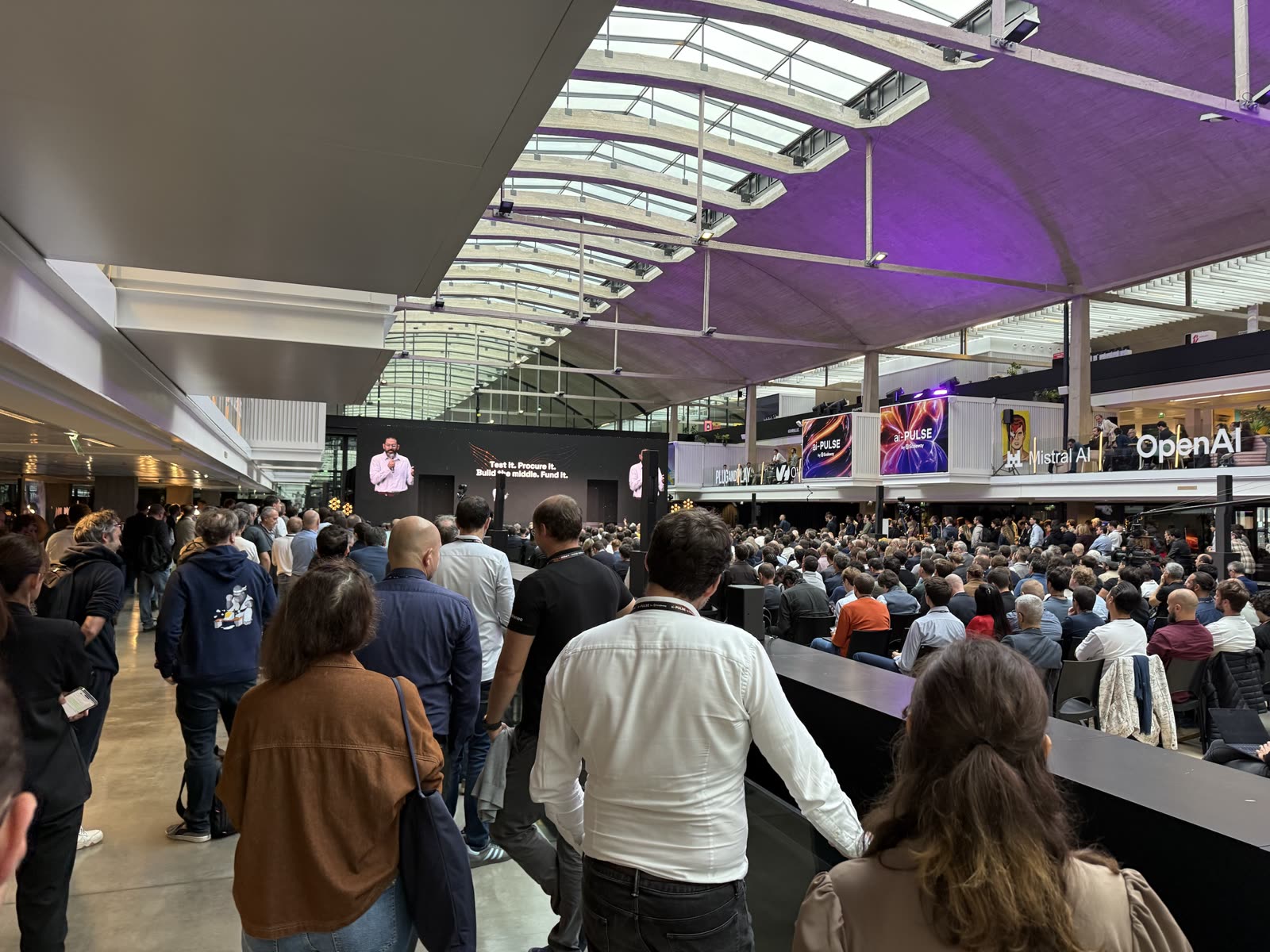
Test, procure, build the middle layer, fund. He broke it down by role. The CTO tests real workflows on open models to keep a choice. The CFO learns how to buy them. Developers build the open stack together. Funders put up the money. The middle layer is neither chips nor foundation models — two areas where Europe will not catch up in the short term. It is tooling, orchestration, security, identity. The niche that is genuinely within reach.
What I take away
Put together, these pieces add up to a fairly coherent strategy. Open models make the provider replaceable. GPUs are arriving in Europe, even if the chips are not yet European. The harness is where value is created and where Europe can compete. And sovereignty, understood as the ability to change your mind, becomes a technical argument rather than a political one.
It remains to be seen whether the argument holds when it is time to sign the purchase order.
The opening keynote is available as a replay on YouTube.